Due: Wednesday, April 2
I Machin's formula for computing p*
(* This problem, in part, is based upon project 1 of Hughes-Hallett et al, Calculus, 3rd edition, page 474.)
In 1706, John Machin - a professor of Astronomy in London - discovered the formula
p/4 = 4 arctan(1/5) - arctan(1/239)
1. Use the 5th degree Maclaurin polynomial for arctan(x) to approximate the value of p. (Historical note: In 1873, William Shanks used this approach to calculate p to 707 decimal places. In 1949, John von Neumann used the ENIAC to compute p up to 2000 digits using Machin's formula. Currently, several billion decimal places are known!)
2. In addition to Machin's formula,
a group of related identities have been discovered, some by famous mathematicians.
These are known as Machin-like
formulas.
Using appropriate Maclaurin polynomials, check
the validity of each of the following:
(A) p/4 = arctan(1/2) + arctan(1/3) (Hutton, 1776)
(B) p/4 = 2 arctan(1/3) + arctan(1/7) (Hutton, 1776)
(C) p/4 = 5 arctan(1/7) + 2 arctan(3/79) (Euler, 1755)
(D) p/4 = 4 arctan(1/5) - arctan(1/70) + arctan (1/99) (Euler, 1764)
(E) p/4 = 12 arctan(1/18) + 8 arctan(1/57) - 5 arctan (1/239) (Gauss, 1863)
(F) p/2
= 2 arctan(1/sqrt(2)) + arctan(1/sqrt(8)) (Wetherfield,
1996)
II Wallis' formula for computing p.
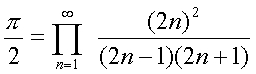
In 1655, John Wallis discovered a beautiful formula for p.
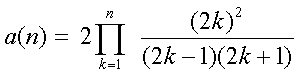
1. Plot the sequence, a(n), and show that the limit as n increases without bound is p. How does the graph indicate the slowness of this convergence?
2. Describe briefly the historical development of the calculation of p.
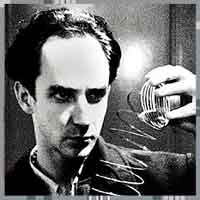
Pi , the movie, directed by Darren Aronofsky